KQs vs QJo
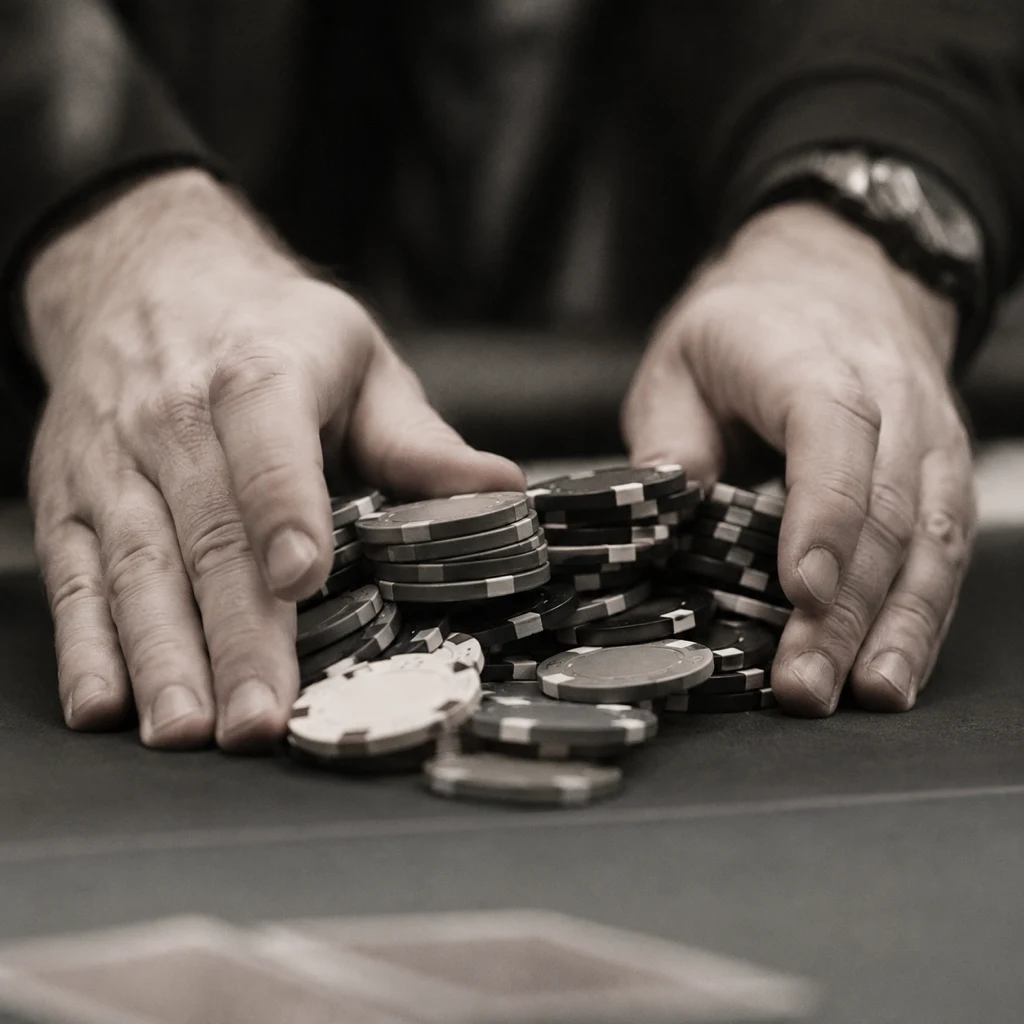
Domination — a shared rank turns this into a kicker fight, and kicker fights are lopsided.
- KQs Win
- 73.8%
- Tie
- 2.4%
- KQs Lose
- 23.7%
- Card combinations
- 36
- KQs vs random
- 63.4% · #16
- QJo vs random
- 58.0% · #39
Win, tie and loss for KQs
When KQs and QJo get all in before the flop, KQs wins 75.1% of the time and QJo takes 24.9%. Broken down, KQs wins outright 73.8%, chops 2.4% and loses 23.7% — a margin of 50.1 points. Domination — a shared rank turns this into a kicker fight, and kicker fights are lopsided.
The same matchup shifts depending on how the suits overlap. With one shared suit the number is 74.8% (for example Ks Qs against Qh Js); with no shared suit it is 75.2% (Ks Qs against Qh Jd). That is a spread of 0.34 points across the 36 distinct card combinations, and it comes almost entirely from whether the two hands are fighting over the same flush.
Add a third player holding a random hand and the split becomes KQs 48.3%, QJo 21.3%, random 30.4%. KQs gives up 26.8 points and QJo gives up 3.7, so the favourite loses more than the underdog does. Extra players always eat into the leader's share faster than into anyone else's.
Taken on their own, KQs is worth 63.4% against a random hand (rank 16 of 169) and QJo is worth 58.0% (rank 39). The gap between them in the ranking is only 5.4 points, yet head to head the gap is 50.1 points — a reminder that a ranking table and a direct matchup are two different questions.
Framed as a run of one hundred identical all-ins, KQs scoops roughly 74 pots, splits about 2, and loses the remaining 24. Against eight random opponents rather than this one specific hand, KQs would be down to 20.4% and QJo to 15.2%, so the shape of this particular confrontation matters far more than either hand's standing in the overall ranking.
From QJo's side, 24.9% is the break-even point for calling an all-in at 3.02:1 pot odds. Put another way, the call is profitable as long as the amount you have to put in is less than 24.9% of the pot you are playing for. KQs holds the other 75.1% of that same pot.
Two caveats keep this figure honest. First, it is showdown equity across all 36 card combinations with five board cards still to come — there is no fold equity in it, so the value of shoving in practice is usually higher than the raw percentage suggests. Second, it assumes QJo really does hold exactly QJo; against the wider range a player would actually get all in with, KQs's 75.1% moves. Use the individual pages for KQs and QJo to see how each of them fares against all 168 other holdings before treating this single pairing as the whole picture.
Overlapping suits move the number
200,000 simulated showdowns per condition. The example column shows one concrete four-card layout.
| Condition | Example | Combos | KQs Equity | Win | Tie | Lose |
|---|---|---|---|---|---|---|
| No shared suit | Ks Qs vs Qh Jd | 24 | 75.2% | 74.0% | 2.4% | 23.6% |
| One shared suit | Ks Qs vs Qh Js | 12 | 74.8% | 73.6% | 2.5% | 23.9% |
Who leads on each street, and how often it flips
Exact counts from the 48 unseen cards: all 17,296 flops × 990 turn-and-river pairs, and all 194,580 four-card turns × 44 rivers, for every suit combination — no simulation.
When the three flop cards are out, KQs is ahead 84.1% of the time and QJo 15.9%, and the two hands are never level on the flop. "Ahead" means the better best-five-card hand from the cards showing plus the two hole cards; draws are not counted.
When KQs leads on the flop, QJo comes back on the turn and river 14.6% of the time. When QJo leads on the flop, KQs turns it around 26.0% of the time. The hand in front holds on to win 81.1% of the time from the flop and 87.9% from the turn (level spots left out).
With the turn out, KQs leads 79.6% and QJo 20.0%. Counted exhaustively, KQs finishes with 74.92% equity (the 75.1% at the top of the page is a 200,000-hand simulation).
| After the flop | How often | KQs wins | Tie | QJo wins |
|---|---|---|---|---|
| KQs ahead | 84.1% | 82.7% | 2.66% | 14.6% |
| Level (same hand) | 0% | Never happens | ||
| QJo ahead | 15.9% | 26.0% | 1.33% | 72.7% |
| After the turn | How often | KQs wins | Tie | QJo wins |
|---|---|---|---|---|
| KQs ahead | 79.6% | 88.8% | 2.41% | 8.78% |
| Level (same hand) | 0.440% | 10.3% | 85.0% | 4.79% |
| QJo ahead | 20.0% | 15.0% | 0.805% | 84.2% |
"Ahead" compares the best five-card hands available at that point (draws are not counted). "Flips" is the share of leads that end in a loss, with level spots left out.
Adding a random third hand
200,000 simulated showdowns, with the third hand dealt at random each time.
At a bigger table
| Random opponents | KQs | QJo |
|---|---|---|
| 1 | 63.4% | 58.0% |
| 2 | 47.2% | 41.2% |
| 4 | 32.3% | 27.1% |
| 8 | 20.4% | 15.2% |
Related
FAQ
KQs or QJo — which is ahead preflop?
KQs is the favourite. KQs takes 75.1% and QJo 24.9%, a margin of 50.1 points, with 2.4% of hands ending in a chop.
Do the suits change KQs vs QJo?
Yes. With one shared suit it is 74.8%, and with no shared suit it is 75.2% — a swing of up to 0.34 points.
What happens three-way?
With one extra random hand in the pot the split is KQs 48.3%, QJo 21.3%, random 30.4%. KQs drops 26.8 points compared with heads-up.
How often does the flop leader lose in KQs vs QJo?
The hand ahead on the flop goes on to lose 16.4% of the time (level spots left out). When KQs leads, QJo comes back 14.6%. When QJo leads, KQs comes back 26.0%. Exact counts over every flop, turn and river.
433 words / 29 distinct figures — Method